Friday, October 14, 2011

Man walks on the Moon


In one of the most famous photographs of the 20th Century, Apollo 11 astronaut Buzz Aldrin walks on the surface of the moon near the leg of the lunar module Eagle. Apollo 11 Commander Neil Armstrong took this photograph with a 70mm lunar surface camera. Armstrong and Aldrin explored the Sea of Tranquility for two and a half hours while crewmate Michael Collins orbited above in the command module Columbia.

As the world remembers the thrilling Apollo 11 mission 35 years later, NASA’s newVision calls for a return to the moon, followed by journeys of discovery to Mars and beyond.

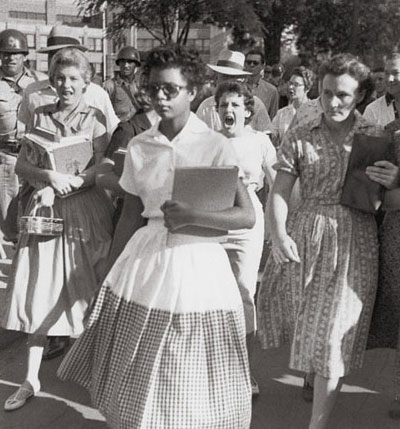
Little Rock Desegregation


In the effort to desegregate the American people on the basis of skin color, the U.S. Supreme Court finally declared that segregated schools are unconstitutional, and that all schools must be segregated from then on. The decision was agreed upon by the school boards and councils across the United States, but the white residents and students were not welcome to the new rule.
On September 4, 1957, nine black students were about to enter Little Rock Central School in Little Rock Arkansas when their entrance was blocked by the white segregationists supported by the Arkansas National Guard. The deployment of the guards was ordered by Arkansas Governor Orval Faubus as a support to his white constituents. The blockade however caused a national issue, which led the President Dwight Eisenhower to intervene and summoned the governor to meet him. Faubus was then reminded not to interfere with the court’s decision.
The first nine black students in Little Rock Central School spent their first few weeks guarded by the police since they were still being blocked by the segregationists to enter the school. They also suffered physical and emotional abuse from their schoolmates. The Little Rock School Board meanwhile was pressured by its citizens to reverse the desegregation, which resulted to its closing in the following school year. It did reopen later on, in fall of 1959.
The thing is… she is not the subject of the photograph. Will Counts, the photographer shot Hazel Massery, the white girl shouting in front of the man. 40 years later she apologized to Elisabeth.

5 year old mother

Into the hospital at Pisco (Peru) came a tired, ragged Indian woman from the foothills of the Andes. She led by the hand a shy little girl, scarcely three feet tall, with chestnut braids and an enormously bulging abdomen. Pointing to the frightened child, the Indian woman begged Surgeon Geraldo Lozada to exorcise the evil spirits which had taken possession of her. Certain that little Lina Medina had an abdominal tumor, Dr. Lozada examined her, and received the surprise of his life when he discovered she was eight months pregnant, making her the world's youngest mother ever.

Dr. Lozada took her to Lima, the capital of Peru, prior to the surgery to have other specialists confirm that Lina was in fact pregnant. A month and a half later, on May 14, 1939, she gave birth to a boy by a caesarean section necessitated by her small pelvis. The surgery was performed by Dr. Lozada and Dr. Busalleu, with Dr. Colretta providing anaesthesia. Her case was reported in detail by Dr. Edmundo Escomel to La Presse Medicale, along with the additional details that her menarche had occurred at 8 months of age, and that she had had prominent breast development by the age of 4. By age 5 her figure displayed pelvic widening and advanced bone maturation.


Her son weighed 2.7 kg (6 lb) at birth and was named Gerardo after her doctor. Gerardo was raised believing that Lina was his sister, but found out at the age of ten that she was his mother. He grew up healthy but died in 1979 at the age of 40 of a disease of the bone marrow. 

There was never evidence that Lina Medina's pregnancy occurred in any but the usual way, but she never revealed the father of the child, nor the circumstances of her impregnation. Dr. Escomel suggested she might not actually know herself by writing that Lina "couldn't give precise responses." Lina's father was arrested on suspicion of rape and incest, but was later released due to lack of evidence. Medina later married Raúl Jurado, who fathered her second son in 1972. They live in a poor district of Lima known as Chicago Chico ("Little Chicago"). She refused an interview with Reuters in 2002. 


There are two published photographs documenting the case. The first one was taken around the beginning of April, 1939, when Medina was seven and a half months into pregnancy. Taken from Medina's left side, it shows her standing naked in front of an inconclusive backdrop (either the side wall of a house with the sun shining on her, or a light-diffusing blanket in a room with an overhead light pointed toward the front of her body). This is the only published photograph of Lina taken during her pregnancy. This photograph is of significant value because it proves Medina's pregnancy as well as the extent of her physiological development. However, this photograph is not widely known outside medical circles. The other photograph is of far greater clarity and was taken a year later in Lima when Gerardo was eleven months old. 


Monday, October 10, 2011

Junko Furuta: The Girl Who Went through 44 days of Torture


This is a true story that happened in Japan in 1988.A 17 year old girl named Furuta Junko, was kidnapped and then tortured by 4 boys with very unimaginable way and finally death after 44 days.


These horrifying things done to Junko Furuta had been collected through the Japanese court trial of the case, and blogs from 1989. They show the pain that Junko Furuta had to endure before she was finally dead. All this had happened to her while she was still alive. They are disturbing, but the truth.
All of this had happened.
-
DAY 1: November 22, 1988: Kidnapped
Kept captive in house, and posed as one of boy’s girlfriend
Raped (over 400 times in total)
Forced to call her parents and tell them she had run away
Starved and malnutritioned
Fed cockroaches to eat and urine to drink
Forced to masturbate
Forced to strip in front of others
Burned with cigarette lighters
Foreign objects inserted into her vagina/anus
DAY 11: December 1, 1988: Severely beat up countless times
Face held against concrete ground and jumped on
Hands tied to ceiling and body used as a punching bag
Nose filled with so much blood that she can only breath through her mouth
Dumbbells dropped onto her stomach
Vomited when tried to drink water (her stomach couldn’t accept it)
Tried to escape and punished by cigarette burning on arms
Flammable liquid poured on her feet and legs, then lit on fire
Bottle inserted into her anus, causing injury
DAY 20: December10, 1988: Unable to walk properly due to severe leg burns
Beat with bamboo sticks
Fireworks inserted into anus and lit
Hands smashed by weights and fingernails kracked
Beaten with golf club
Cigarettes inserted into vagina
Beaten with iron rods repeatedly
Winter; forced outside to sleep in balcony
Skewers of grilled chicken inserted into her vagina and anus, causing bleeding
DAY 30: Hot wax dripped onto face
Eyelids burned by cigarette lighter
Stabbed with sewing needles in chest area
Left nipple cut and destroyed with pliers
Hot light bulb inserted into her vagina
Heavy bleeding from vagina due to scissors insertion
Unable to urinate properly
Injuries were so severe that it took over an hour for her to crawl downstairs and use the bathroom
Eardrums severely damaged
Extreme reduced brain size
DAY 40: Begged her torturers to “kill her and get it over with”
January 1, 1989: Junko greets the New Years Day alone
Body mutilated
Unable to move from the ground
DAY 44: January 4, 1989: The four boys beat her mutilated body with an iron barbell, using a loss at the game of Mah-jongg as a pretext. She is profusely bleeding from her mouth and nose. They put a candle’s flame to her face and eyes.
Then, lighter fluid was poured onto her legs, arms, face and stomach, and then lit on fire. This final torture lasted for a time of two hours.

Junko Furuta died later that day, in pain and alone. Nothing could compare 44 days of suffering she had to go through.

When her mother heard the news and details of what had happened to her daughter, she fainted. She had to undergo a psychiatric outpatient treatment . Imagine her endless pain.

Her killers are now free men. Justice was never served, not even after 20 years.
They deserve a punishment much greater than they had put upon Furuta, for putting an innocent girl through the most unbearable suffering.


The crime:
On November 25, 1988, four boys, including Jō Kamisaku, then 17 (Kamisaku was a new family name he took after being released from prison), abducted and held Furuta, a second-year high school (11th grade) student from Misato, Saitama Prefecture, for 44 days. They kept her captive in the house owned by the parents of Kamisaku, located in the Ayase district of Adachi, Tokyo.

To forestall a manhunt, one of them forced Furuta into calling her own parents and telling them that she had run away from home, but was with "a friend" and was not in danger. He also browbeat her into posing as the girlfriend of one of the boys when his (Kamisaku's) parents were around, but when he was sure they would not call the police, he dropped the pretext. Furuta tried to escape several times, begging the parents to help her, but they did nothing, apparently out of fear that Yokoyama would hurt them. Yokoyama was at the time a low-level yakuza leader and had bragged that he could use his connections to kill anyone who interfered.

According to their statements at their trial, the four of them raped her, beat her, introduced foreign objects including an iron rod into her vagina, made her drink her own urine and was fed cockroaches, inserted fireworks into her anus, and set them off, forced Furuta to masturbate, cut her nipple with pliers, dropped dumbbells onto her stomach, and burned her with cigarettes and lighters. (One of the burnings was punishment for attempting to call the police.)At one point her injuries were so severe that according to one of the boys it took more than an hour for her to crawl downstairs to use the bathroom. They also related that “possibly a hundred different people” knew that Furuta had been imprisoned there, but it is not clear if this means they visited the house at different times while she was imprisoned there, or themselves either raped or abused her.When the boys refused to let her leave, she begged them on several occasions to “kill (her) and get it over with“.

On January 4, 1989, using one of the boys’ loss at mah-jongg as a pretext, the four beat her with an iron barbell, poured lighter fluid on her legs, arms, face and stomach, and set her on fire. She died later that day of shock.The four boys claimed that they were not aware of how badly injured she was, and that they believed she had been malingering.After her death, the killers taped her arms and legs together, threw her into a 55-gallon drum, filled it with cement, and disposed the drum in a tract of reclaimed land in Koto, Tokyo

Arrest and punishment
The boys were arrested and tried as adults; but, because of Japanese handling of crimes committed by juveniles, their identities were sealed by the court. However, a weekly magazine Shukan Bunshun reported their real names, claiming “Human rights aren’t needed for brutes.” Furuta’s real name and details about her personal life were reported exhaustively in the media. Kamisaku was judged as a sub leader, at least according to the official trial.

The four boys pled guilty to a reduced charge of “committing bodily injury that resulted in death“, rather than murder. Boy A’s parents sold their house for approximately 50 million yen and paid this as compensation to Furuta’s family.

For his participation in the crime, Kamisaku served eight years in a juvenile prison before he was released, in August 1999. In July 2004, he was arrested for assaulting an acquaintance, whom he believed to be luring a girlfriend away from him, and allegedly bragged about his earlier infamy. Kamisaku was sentenced to seven years in prison for the beating.

Junko’s parents were dismayed by the sentences received by their daughter’s killers, and enjoined a civil suit against the parents of the boy in whose home the crimes were committed. When some of the convictions were overturned on the basis of problematic physical evidence (the semen and pubic hair recovered from the body did not match those of the boys who were arrested), the lawyer handling the civil suit decided there was no case to be made and refused to represent them further. (There is speculation that the evidence may have been contaminated—for example, by unidentified persons who raped Furuta.)

One of the most disturbing parts of this true story is that her killers are now free. After putting Junko Furuta through all that suffering, they are free men!!! And only have 8 years in prison.


Rest In Eternal Peace,
Junko Furuta
1989-Eternity


Sunday, October 9, 2011

Kuchisake Onna

Kuchisake Onna, also known as The Slit-Mouth Woman, is a scary Japanese urban legend about a disfigured Japanese woman who brandishes a large scissors and preys on children. She has an enormous slit mouth, which extends from ear to ear in a horrible, permanent smile.


The Slit Mouth Woman walks the streets of Japan, wearing a surgical mask and hunting for children. If you cross her path, she will stop you and ask you a question. If you give her the wrong answer, there will be horrible consequences.


Picture the scene. You are walking home from school and your path takes you down a deserted city street. Suddenly, you hear a faint noise coming from the shadows. You glance over and see a beautiful woman standing there. She has long black hair and is wearing a beige trenchcoat. A surgical mask covers the lower half of her face. In Japan, wearing a surgical mask is not uncommon during flu season, to prevent spreading germs.

She steps out of the shadows and blocks your path.

“Am I beautiful?” she asks.

Before you can answer, she tears off her mask, revealing a hideously deformed face. Her huge mouth is sliced from ear to ear and gapes open revealing rows of sharp teeth and a big red disgusting tongue twisting and twirling inside.

“Am I beautiful NOW?” she screams.

Terrified, you struggle to answer her. If you say “No”, she pulls out a huge pair of scissors and kills you immediately, chopping off your head. If you say “Yes”, she takes her scissors and slices your mouth from ear to ear, making you look just like her. If you try to run away, she will hunt you down and kill you, by slicing you in two.

The only way to escape from Kuchisake Onna is to give a non-committal answer. If you say “You look average” or you look normal, she will be confused, giving you just enough time to run away.

There are many rumors about how Kuchisake Onna got her horribly disfigured mouth. Some say that her slit mouth is the result of plastic surgery that went horribly wrong. Others say that she was injured in a terrible car crash. Some even believe she is an escaped mental patient who was so demented that she cut her own mouth apart.

According to one legend, years ago, in Japan, there lived a very beautiful woman who was extremely vain and self-absorbed. Her husband was a very jealous and brutal man and he became convinced that she was cheating on him. In a fit of rage, he took a sword and slit her mouth from ear to ear, screaming “Who will think you’re beautiful now?” She became a vengeful spirit, and began wandering the streets of Japan, wearing a surgical mask to hide her terrible scars.

The Slit Mouth Woman’s reign of terror began in the spring and summer of 1979, when rumors began to spread throughout Japan about sightings of the Kuchisake-onna hunting down children. The story spread like wildfire and actually created scares in many towns. Police increased their patrols and schools sent teachers to walk students home in groups.

In 2004, South Korea was plagued by reports of a red-masked woman who was chasing children.

In 2007, a coroner found some old records from the late 1970s about a woman who was chasing little children, but was hit by a car, and died shortly after. Her mouth was ripped from ear to ear.

The USA has its own version of Kuchisake Onna. There were rumors about a clown who appeared in public bathrooms and accosted children, asking “Do you want death or happy smile?” if they chose “happy smile”, he took out a knife and slit their mouths from ear to ear.


Saturday, October 8, 2011

Gandhi at his Spinning Wheel


"Gandhi at his Spinning Wheel," the defining portrait of one of the 20th century’s most influential figures, almost didn’t happen, thanks to the Mahatma’s strict demands. Granted a rare opportunity to photograph India’s leader; Life staffer Margaret Bourke-White was all set to shoot when Gandhi’s secretaries stopped her cold: If she was going to photograph Gandhi at the spinning wheel (a symbol for India’s struggle for independence), she first had to learn to use one herself.

But that wasn’t all. The ascetic Mahatma wasn’t to be spoken to (it being his day of silence.) And because he detested bright light, Bourke-White was only allowed to use three flashbulbs. Having cleared all these hurdles, however, there was still one more – the humid Indian weather, which wreaked havoc on her camera equipment. When time finally came to shoot, Bourke-White’s first flashbulb failed. And while the second one worked, she forgot to pull the slide, rendering it blank.

She thought it was all over, but luckily, the third attempt was successful. In the end, she came away with an image that became Gandhi’s most enduring representation. it was also among the last portraits of his life; he was assassinated less than two years later.

The Corpse of Che Guevara


Sociopathic thug? Socialist luminary? Or as existentialist Jean-Paul Sartre called him, "the most complete human being of our age"? Whatever you believe, there’s no denying that Ernesto "Che" Guevara has become the patron saint of revolutionaries. Undeniably, he is a man of mythical status – a reputation that persists less because of how he lived than because of how he died.

Unenthused by his efforts to incite revolution among the poor and oppressed in Bolivia, the nation’s army (trained and equipped by the U.S. military and the CIA) captured and executed Guevara in 1967. But before dumping his body in a secret grave, they gathered around for a strategic photo op. They wanted to prove to the world that Che was dead, in hopes that his political movement would die with him. in fact, anticipating charges that the photo had been faked, Che’s thoughtful captors amputated his hands and preserved them in formaldehyde.

But by killing the man, Bolivian officials unwittingly birthed his legend. The photo, which circulated around the world, bore a striking resemblance to Renaissance paintings of Christ taken down from the cross. Even as Che’s killers preened and gloated above him (the officer on the right seems to be inadvertently pointing to a wound on Guevara’s body near where Christ’s final wound was inflicted), Che’s eerily peaceful face was described as showing forgiveness. The photo’s allegorical significance certainly wasn’t lost on the revolutionary protesters of the era. They quickly adopted "Che lives!" as a slogan and rallying cry. Thanks to this photograph, "the passion of the Che" ensured that he would live on forever as a martyr for the socialist cause.

Hindenburg


Forget the Titanic, the Lusitania, and the comparatively unphotogenic accident at Chernobyl. Thanks to the power of images, the explosion of the Hindenburg on May 6, 1937, claims the dubious honor of being the quintessential disaster of the 20th century.

In the grand scheme of things, however, the Hindenburg wasn’t all that disastrous. Of the 97 people aboard, a surprising 62 survived. (in fact, it wasn’t even the worst Zeppelin crash of the 20th century. Just four years earlier, the U.S.S. Akron had crashed into the Atlantic killing more than twice as many people.) But when calculating the epic status of a catastrophe, terrifying photographs and quotable quotes ("Oh, the humanity!") far outweigh body counts.

Assembled as part of a massive PR campaign by the Hindenburg’s parent company in Germany, no fewer than 22 photographers, reporters, and newsreel cameramen were on the scene in Lakehurst, N.J. when the airship went down. Worldwide publicity of the well-documented disaster shattered the public’s faith in Zeppelins, which were, at the time, considered the safest mode of air travel available.

During the 1920s and 1930s, Zeppelins had operated regular flights, totting civilians back and forth between Germany and the Americas. But all of that stopped in 1937. The incident effectively killed the use of dirigibles as a commercially viable mode of passenger transport, ending the golden age of the airship not with a whimper, but with a horrific bang that was photographed and then syndicated around the globe.

Federal Dead on the Field of Battle of First Day, Gettysburg, Pennsylvania


As one of the world’s first war photographers, Mathew Brady didn’t start
out having as action-packed a career as you might think. A successful daguerreotypist and a distinguished gentleman, Brady was known for his portraits of notable people such as Abraham Lincoln and Robert E. Lee. In other words, he was hardly a photojournalist in the trenches.

In fact, Brady had everything to lose by making a career move – his money, his business, and quite possibly his life. Nevertheless, he decided to risk it all and follow the Union Army into battle with his camera, saying, "A spirit in my feet said, ‘Go!’" And go he did – at least until he got a good look at the pointy end of a Confederate bayonet.

After narrowly escaping capture at the first Battle of Bull Run, Brady’s chatty feet quieted down a bit, and he began sending assistants in his place. In the span of only a few years, Brady and his team shot more than 7,000 photographs – an astounding number when you consider that developing a single plate required a horse-drawn-wagon-full of cumbersome equipment and noxious chemicals. Not exactly what you’d call "point-and-shoot."

Tethered as he was to his equine-powered darkroom and with film speeds being much slower then, Brady produced war photos that are understandably light on the action and heavy on the aftermath. Still, they mark the first time Americans were so immediately confronted with the grim realities of the battlefield.

Migrant Mother


As era-defining photographs go, "Migrant Mother" pretty much takes the cake. For many, Florence Owens Thompson is the face of the Great Depression, thanks to legendary shutterbug Dorothea Lange. Lange captured the image while visiting a dusty California pea-pickers’ camp in February 1936, and in doing so, captured the resilience of a proud nation facing desperate times.

Unbelievably, Thompson’s story is as compelling as her portrait. Just 32 years old when Lange approached her ("as if drawn by a magnet," Lange said). Thompson was a mother of seven who’d lost her husband to tuberculosis. Stranded at a migratory labor farm in Nipomo, Calif. her family sustained themselves on birds killed by her kids and vegetables taken from a nearby field – as meager a living as any earned by the other 2,500 workers there. The photo’s impact was staggering. Reproduced in newspapers everywhere, Thompson’s haunted face triggered an immediate public outcry, quickly prompting politicos from the federal Resettlement Administration to send food and supplies. Sadly, however, Thompson and her family had already moved on, receiving nary a wedge of government cheese for their high-profile misery. In fact, no one knew the identity of the photographed woman until Thompson revealed herself years later in a 1976 newspaper article.


meat in fridge


“A lady from the Philippines has killed many people and kept their meat in her refrigerator, and has enjoyed eating it.

She said she had made so many parties for her friends and relatives and gave them this human meat to eat without their knowledge. Her guests said that they found very good taste in this lady’s cooking but didn’t know what meat it was. Some of them didn’t know they’d be her next victim. She also killed and consumed her husband.”


Friday, October 7, 2011

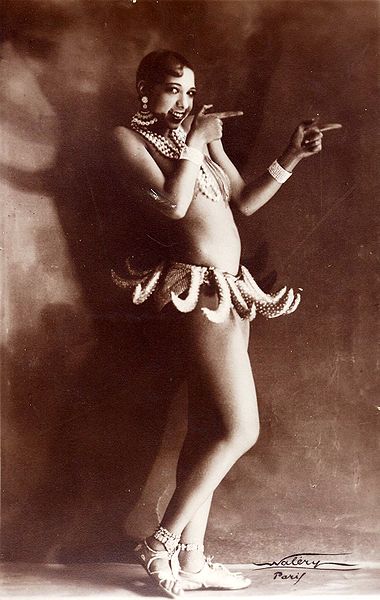
Josephine Baker

Baker costumed for the Danse banane from the Folies Bergères production Un Vent de Folie in Paris in 1927, her most famous banana costume.


Josephine Baker famous singer & dancer. Baker was born June 3, 1906, she died on April 12, 1975. She lived at a time of severe oppression of the blacks. At age 13 she ran away and went on a tour to Paris. In France Baker was embraced despite her color and her dancing style made her the talk of Europe.

During World War II she helped the French Resistance. She adopted 12 kids of many different races. When she returned to the U.S. The Stork Club refused to serve her because she was black.

In 1963 Baker spoke to the crowd with Martin Luther King at the Lincoln Memorial at March on Washington.

Josephine Baker in Havana, Cuba  1950

Hurricane Irene


 ”Officials survey the damage to Route 12 on Hatteras Island, N.C., on Aug. 28 2011. Hurricane Irene swept through the area Saturday cutting the roadway in five locations. Irene caused more than 4.5 million homes and businesses along the East Coast to reportedly lose power over the weekend, and at least 11 deaths were blamed on the storm.” Roughly 2,500 people are stuck on Hatteras Island as a result of this.

Thursday, October 6, 2011

Mother’s Sacrifice


This is a true story of Mother’s Sacrifice during the Japan Earthquake.
After the Earthquake had subsided, when the rescuers reached the ruins of a young woman’s house, they saw her dead body through the cracks. But her pose was somehow strange that she knelt on her knees like a person was worshiping; her body was leaning forward, and her two hands were supporting by an object. The collapsed house had crashed her back and her head.

With so many difficulties, the leader of the rescuer team put his hand through a narrow gap on the wall to reach the woman’s body. He was hoping that this woman could be still alive. However, the cold and stiff body told him that she had passed away for sure.
He and the rest of the team left this house and were going to search the next collapsed building. For some reasons, the team leader was driven by a compelling force to go back to the ruin house of the dead woman. Again, he knelt down and used his had through the narrow cracks to search the little space under the dead body. Suddenly, he screamed with excitement,” A child! There is a child! “
The whole team worked together; carefully they removed the piles of ruined objects around the dead woman. There was a 3 months old little boy wrapped in a flowery blanket under his mother’s dead body. Obviously, the woman had made an ultimate sacrifice for saving her son. When her house was falling, she used her body to make a cover to protect her son. The little boy was still sleeping peacefully when the team leader picked him up.
The medical doctor came quickly to exam the little boy. After he opened the blanket, he saw a cell phone inside the blanket. There was a text message on the screen. It said,” If you can survive, you must remember that I love you.” This cell phone was passing around from one hand to another. Every body that read the message wept. ” If you can survive, you must remember that I love you.” Such is the mother’s love for her child!!

Albert Einstein


Albert Einstein is probably one of the most popular figures of all times. He is considered a genius because he created the Theory of Relativity, and so, challenged Newton’s laws, that were the basis of everything known in physics until the beginning of the 20th century. But, as a person, he was considered a beatnik, and this picture, taken on March 14, 1951 proves that.


On Einstein's 72nd birthday in 1951, United Press International (UPI) photographer Arthur Sasse was trying to persuade him to smile for the camera, but having smiled for photographers many times that day, Einstein stuck out his tongue instead . This photo became one of the most popular photos ever taken of Einstein and it is well recognized in popular culture, often used in merchandise depicting Einstein in a light-hearted sense.

I've seen this picture loads of times somehow i always thought it was fake , you know through the power of photoshop and all that . But the picture checks out its Real .

Face off during the Oka Crisis


This is probably Canada’s most famous picture. The Oka Crisis was a land dispute between the Mohawk nation and the town of Oka, Quebec which began on March 11 1990, and lasted until September 26 1990. It resulted in three deaths, and would be the first of a number of violent conflicts between Indigenous people and the Canadian Government in the late 20th century.

The pillar of fire


On the night of January 24, 1950, one of the most amazing photographs (right figure) of all time was taken in the Sam Houston Coliseum, Houston, Texas. As William Branham (an influential Bible minister sometimes credited with founding the Latter Rain Movement within American Pentecostal churches) stood at the podium, a halo of fire appeared above his head. This picture was the only one that turned out on the entire film! George J. Lacy, Investigator of Questioned Documents, and often hired by the FBI in that capacity, subjected the negative to every scientific test available. At a news conference, he stated, “To my knowledge, this is the first time in all the world’s history that a supernatural being has been photographed and scientifically vindicated.” The original of this photograph is kept in the archives of the Religious Department of the Smithsonian Institute, Washington, D.C.

Lunchtime atop a Skyscraper


Lunch atop a Skyscraper (New York Construction Workers Lunching on a Crossbeam) is a famous photograph taken by Charles C. Ebbets during construction of the GE Building at Rockefeller Center in 1932.

The photograph depicts 11 men eating lunch, seated on a girder with their feet dangling hundreds of feet above the New York City streets. Ebbets took the photo on September 29, 1932, and it appeared in the New York Herald Tribune in its Sunday photo supplement on October 2. Taken on the 69th floor of the GE Building during the last several months of construction, the photo Resting on a Girder shows the same workers napping on the beam.

Loch Ness Monster


One of the most iconic images of Nessie is known as the ‘Surgeon’s Photograph’, which many formerly considered to be good evidence of the monster. Its importance lies in the fact that it was the only photographic evidence of a “head and neck” – all the others are humps or disturbances.The image was revealed as a hoax in 1994.
Supposedly taken by Robert Kenneth Wilson, a London gynaecologist, it was published in the Daily Mail on 21 April 1934. Wilson’s refusal to have his name assoiciated with the photograph lead to the moniker “Surgeon’s Photograph.”The photo is often cropped to make the monster seem huge, while the original uncropped shot shows the other end of the loch and the monster in the centre. The ripples on the photo fit the size and circular pattern of small ripples as opposed to large waves when photographed up close. Analyses of the original uncropped image have fostered further doubt.
In 1979 it was claimed to be a picture of an elephant. Other sceptics in the 1980s argued the photo was that of an otter or a diving bird, but after Christian Spurling’s confession most agree it was what Spurling claimed – a toy submarine with a sculpted head attached. The details of how it was done have been given in a book. Essentially, it was a toy submarine with a head and neck made of plastic wood, built by Christian Spurling, the son-in-law of Marmaduke Wetherell, a big game hunter who had been publicly ridiculed in the Daily Mail, the newspaper that employed him. Spurling claimed that to get revenge, Marmaduke Wetherell committed the hoax, with the help of Chris Spurling (a sculpture specialist), his son Ian Marmaduke, who bought the material for the fake Nessie, and Maurice Chambers (an insurance agent), who would call to ask surgeon Robert Kenneth Wilson to offer the pictures to the Daily Mail. The hoax story is disputed by Henry Bauer, who claims this debunking is evidence of bias, and asks why the perpetrators did not reveal their plot earlier to embarrass the newspaper. He also claimed that plastic wood did not exist in 1934, although it was a popular DIY and modelling material in the early 1930s.

Fire on Marlborough Street


On July 22, 1975, photograph Stanley J. Forman working for the Boston Herald American newspaper when a police scanner picked up an emergency: “Fire on Marlborough Street!”
Climbed on a the fire truck, Forman shot the picture of a young woman, Diana Bryant, and a very young girl, Tiare Jones when they fell helplessly. Diana Bryant was pronounced dead at the scene. The young girl lived. Despite a heroic effort, the fireman who tried to grab them had been just seconds away from saving the lives of both.

Photo coverage from the tragic event garnered Stanley Forman a Pulitzer Prize. But more important, his work paved the way for Boston and other states to mandate tougher fire safety codes.